CERVIM international congress 2026
From May 6 to 8, 2026, and for the very first time, the International Congress of the Centre for Research, Environmental Sustainability and Advancement of Mountain Viticulture (CERVIM) was held in Switzerland, in Montreux, on the shores of Lake Geneva and at the foot of the Alps. Through state-of-the-art lectures on mountain viticulture in Switzerland and around the world, nearly one hundred experts gathered to provide solutions aimed at ensuring its sustainable preservation.
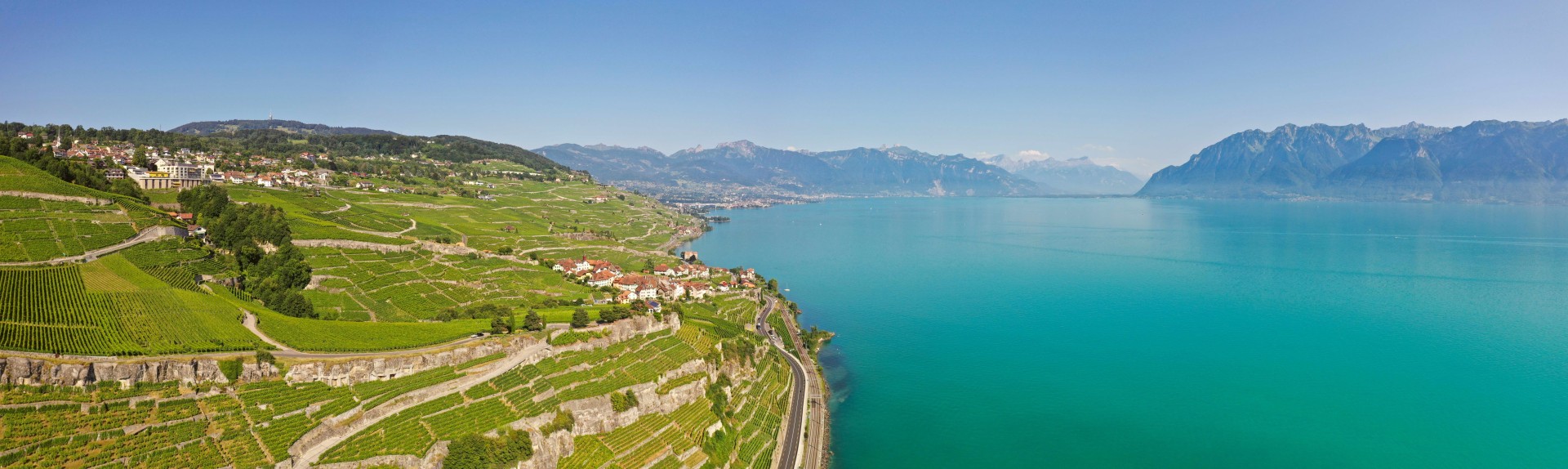
Heroic vineyards: inspirational for worldwide viticulture
For this 8th edition, the CERVIM Congress, held under the patronage of the International Organisation of Vine and Wine (OIV), was specifically focused on the particularly challenging situation currently affecting global viticulture, and more specifically mountain and steep-slope viticulture.
The global wine market is suffering from constant wine consumption decline, fierce competition between wine-producing countries, increasing production costs, strict requirements for more and more sustainability in agricultural practices, as well as fast-evolving expectations from consumers. Such considerations strongly contributed to the design of the programme proposed at this year's congress on "heroic" viticulture.
During three days, international experts will expose the situation, suggest opportunities to investigate, and hopefully come up with answers to the challenges that wine-making actors encounter in mountainous environments. They are acutely vulnerable to the changes affecting the conditions of their very existence.
Contributions to the Congress
As part of the Congress, a significant number of scientific contributions were produced and presented by around sixty researchers, professors, and experts from European institutes and research centers.
You will find a summary of their research in the “Book of Abstracts” available here.
You will also find copies of the various presentations given by the speakers.
PRESENTATIONS
Wednesday, 6 May 2026
- 08:50
Presentation of the congress – Dr. D. Tomasi
- 09:00
Statistical and economic data on global and heroic viticulture – Dr. A. Mondoux
- 09:45
Importance and role of heroic vineyards in Alsace, France – F. Schwaerzler
- 10:05
Situation and perspectives of heroic viticulture in Douro – Dr. J. Queiroz
- 10:25
Italians heroic vineyards – Dr. D. Tomasi
Italians heroic vineyards – U. Marchiori- 10:45
The challenges of heroic viticulture in Switzerland – Dr. O. Viret
- 13:15
Historical and heroic landscape to preserve through certification programs – Pomatto, Devecchi
- 13:30
Unique landscapes: how online reviews reveal the Lavaux visitor experience – Mele et al.
- 13:45
Functional biodiversity in heroic terraced viticulture: a heritage-based conservation approach across Italian national Parks – Gagnarli et al.
- 14:15
The multifunctional value of historical viticulture as living heritage – Santoro et al.
Thursday, 7 May 2026
- 08:45
Recovery strategy of the CollioureBanyuls heroic vineyards: terroir zoning, productarea adequacy and collective positioning – Akhiridinov et Gautreau
- 09:00
A post-growth paradigm for wine law: learning from heroic viticulture – Reinhardt, Noufaily et Monaco
- 09:15
Understanding the expression of time in Chasselas wines – Blackford et al.
- 09:30
Turning environmental commitment into economic value: a viticulture case study from the Yvorne region (Switzerland) – Heger et al.
- 09:40
Climate-adaptive viticulture and territorial fragility – Perucchini et al.
- 09:50
Soil water availability in steep slope vineyards, A case study of different systematizations in the Douro Region – Valente et Alves
- 10:30
Overview of non-herbicide soil management solutions in non- or poorly mechanized terraced vineyards – Marchand et Sonnard
- 10:45
Water balance modeling for terroir characterization and adaptative management in extreme viticulture – Tarditi et al.
- 11:00
Physiological and management-based adaptation of mountain vineyards to increase water stress under Mediterranean climate – Malheiro and Moutinho-Pereira
- 11:15
From soil to grape: multi-scale monitoring and precision irrigation in Madeira vineyards – Ragonezi et al.
- 11:30
Unmanned aerial system for crop protection in heroic viticulture: an eight-year field assessment – Pagliai et al.
- 11:40
Elevation-driven microclimates shape physiological, metabolomic, and microbial terroir in a steep-slope vineyard network in Lavaux (Switzerland) – Rienth et al.
- 11:50
Influence of slope and topography on aroma composition and sensory profile of Glera grapes in the Conegliano Valdobbiadene PDO – Marcuzzo et al.
- 12:00
Climatic and morphological variability in alpine viticulture: effects on Nebbiolo production in Valtellina – Bianchi et al.
- 12:10
Sustainable management of invasive plants in a steep slope vineyard – Delavallade et al.
- 12:20
Slope of the terrace embankment matters ? A case study reviewing geometry terraces in Douro Region – Alves, Valente, Pereira
POSTERS
- Agenzia LAORE Sardegna & Università degli Studi di Sassari
- AgroSustain & Agroscope
Innovative Solution to protect vineyard against climate variability
- Catalan Institute of Vine and Wine & Institute of Agrifood Research and Technology
- Chamber of Agriculture and Forestry of Slovenia
- Changins, University of Fribourg & University of Neuchâtel
- CREA - Research Centre for Viticulture and Enology, Arezzo
- Fondazione Edmund Mach
“PIWI” grape varieties authorized in Trentino : 3 years of observations (2023-2025)
- Fondazione Edmund Mach
The selection of new genotypes with resistance traits, originating from Chardonnay and Schiava
- Institut Agricole Régional, Aosta
Protective effect of kaolin in preventing grape sunburn on Petit rouge : first results
- Instituto Tecnológico Agrario de Castilla y León
- Association Lavaux World Heritage
Preliminary study on land improvements for the vine walls of Lavaux
- AgroMarienseCoop
- Università di Torino & Fondazione Giovanni Dalmasso
Maintaining and developing the viticulture and Oenological heritage of the Mombarone terraces